13 gennaio 2023

Tesla crash on San Francisco Bay Bridge. What actually happened?

On November 24, 2022, a Tesla Model S caused an eight-vehicle crash in San Francisco. Let's clarify what happened.

Where the accident took place

The accident occurred inside the San Francisco Bay Bridge, exactly here.

What do websites say about a Tesla rear-end collision in San Francisco?

Articles like this one immediately appeared on the internet , where they complain about "Full Self Driving Mode " and " phantom braking".


Other articles reports (like this one from abc7news.com) that Tesla was "abruptly braking":


Video from security cameras


Video captured by security cameras can be found in this article from theintercept.com. Let's analyze it. I used a VLC plugin to superimpose the elapsed time onto the movie.

This is the first instant where the Tesla Model S is seen (9 seconds and 336 milliseconds):

At 10.951 seconds the blinker is still off.

In the next frame (11.025 seconds) the turn signal is on.


Was FSD actually switched on?

The fact that the car was in "Full Self Driving" mode is a driver statement. The driver told the police that he had been using Tesla’s new “Full Self-Driving” feature, before the Tesla’s “left signal activated” and its “brakes activated,” and it moved into the left lane, “slowing to a stop directly in [the second vehicle’s] path of travel.”

The driver might have lied trying to escape his responsibilities.

In any case, the driver demonstrates that he does not know the various Tesla assisted driving modes, which, as explained here , are as follows:

  • Autopilot
    • Traffic-Aware Cruise Control
    • Autosteer
  • Enhanced Autopilot
    • Navigate on Autopilot
    • Auto Lane Change
    • Car park
    • Summon
    • Smart Summon
  • Full Self-Driving Capability
    • Traffic and Stop Sign Control (Beta)

The Full Self-Driving Capability is active inside the city, not on multi-lane roads or freeways. It is more probable that Enhanced Autopilot with the "Navigate on Autopilot" functionality was active, rather than the "Full Self Driving".

Was it a Phantom Brake phenomenon?

The "phantom brake" occurs when, during normal travel following the lane, the autopilot system sees an obstacle that does not actually exist and therefore brakes violently. Here the car turn on blinker, change lane and stops, so I exclude that it braked due to the "phantom brake" phenomenon.

Was Tesla abruptly braking?

I also exclude that this was an abrupt braking. Now I'll tell you why. Below is the instant in which the turn signal lights up (11 sec and 87 msecs). I highlighted the distance between this instant and the point where the car stopped.

We can count four horizontal dashed lines. What is the distance between one line and another? Google Earth helps us, with the measure function. It's 14 meters (the length of the white stripe alone is 4 meters).


We can estimate how many meters separate the car from the moment the turn signal is on to the moment it stops.


We have 56 meters, covered in about 4.7 seconds (15.813 sec – 11.087 sec). The speed limit on this road is 50 mph, which corresponds to about 80 km/h.

The cars were travelling respecting speed limits, as you can see here:


Look at the car pointed by the red arrow. It traveled 14 meters between the two frames:


Doing the math, this car is traveling within the speed limits of 50 mph (14 meters in 0.668 seconds = 20.95 metres/sec = 75 km/h).
And how long does it take to stop a Tesla Model S? At 100 km/h he needs 41 meters to stop in an emergency (source: quattroruote ). I wouldn't really define it an "abrupt braking", given that the Model S stopped in 56 meters starting from less than 80 km/h.

So what really happened during the Tesla pileup in San Francisco?

There are ongoing investigations. Tesla will probably make the logs available  and they will clarify what actually happened. I don't know exactly what happened. I think the driver wasn't vigilant when the car was braking: he had almost 5 seconds to accelerate and avoid a rear-end collision. And if driver assistance systems were actually active? In any case it is driver's responsibility to take control of the vehicle in case the automatic systems make mistakes. I blame also the drivers behind the Model S: they did not keep a safe distance.
Hope that you liked this article, see you next time!
Leonardo


30 dicembre 2016

Civilization 3 - La patch che aggiorna all'ultima versione il gioco in italiano

Ciao a tutti,

Oggi vorrei parlarvi di un gioco un po' datato ma che ha fatto la storia: Civilization 3.

E' un gioco che mi ha sempre appassionato e che recentemente, preso da un attacco di nostalgia, ho deciso di ricomprare.
Trovo una occasione su Ebay e lo acquisto (ho trovato la versione originale, denominata Vanilla). 
Mi arriva la splendida confezione in cartone con dentro il manuale in lingua italiana.
Fantastico!!!!!


Ma quando provo ad installarlo ho la prima sorpresa. Non mi ricordavo che bisognava sempre inserire il CD del gioco per farlo funzionare. E sui nuovi portatili il lettore di CD non esiste nemmeno più!!!
Niente paura, i primi anni 2000 erano gli anni d'oro dei forum, ci sarà sicuramente una soluzione!
Scopro che c'è un sito meraviglioso che si chiama Civfanatics (https://www.civfanatics.com/) che raccoglie tutto lo scibile su questo gioco.
Scopro che c'è una patch ufficiale (fatta da una rivista di giochi, www.pcgames.de) che permette di giocare senza inserire il CD.
Scopro che purtroppo quella patch è stata fatta per la versione 1.29f mentre il cd mi installa la 1.16.
Sul sito Civfanatics c'è il file per aggiornare il gioco alla versione 1.29f, ma funziona solo se la versione di partenza è in lingua inglese! 
Era stato fatto il file di aggiornamento anche per la versione in lingua italiana, ma non si trova più in rete.
Per fortuna ho trovato un appassionato che mi ha dato la possibilità di scaricare tale file: civ3v129fi.exe
Ho pensato di zipparlo e di renderlo disponibile alla comunità. 

il file civ3v129fi.zip che permette di aggiornare Civ3 vanilla edition alla versione 1.29f è disponibile al seguente link:

https://1drv.ms/u/s!AhObrcLH0_zEevvcBP6vboJTKm0

L'eseguibile che potete trovare all'interno dello zip è lungo 9.444.552 bytes 

L'MD5 Hash è il seguente (calcolato con il comando FCIV -md5 civ3v129fi.exe):

AD61DF6805EF6C783EB2DB3B1FC32794 // File Checksum Integrity Verifier version 2.05.

Ciaoooo!

LoScettico


6 giugno 2016

Lonato F100 Pics Garda Cup - Final - Part 4 of 4


Dear '90s Kart passionate,

This is my last set of 2016 Garda Cup photo. 
All pics are of pre 89 and pre 95 classes.


If you liked my pics please feel free to make a donation.
It's easy, click on the donate button and follow the instructions :-)
(it could take up to 10-15 seconds on mobile devices)


--------------------- --------------------- -----------------------------
Push this button to gain access to final pictures!!!


-----------------------------------------------------------------------

Thanks for visiting my blog, and hope you enjoyed the event...


29 maggio 2016

Lonato F100 Pics Garda Cup - Final - Part 3 of 4


Dear '90s Kart passionate,

In this set of photo I finally reveal some of Pippo Sicuranza driving secrets.

Here for example he's fine adjusting carburation:

And here he's cooling the engine by closing airbox holes:

Many others have been photographed while closing airbox holes or adjusting carburetors:


I'll let you find the others!!!

After this set of photos, I have only one more set of pre89 and pre95 classes.

If you liked my pics please feel free to make a donation.
It's easy, click on the donate button and follow the instructions :-)
(it could take up to 10-15 seconds on mobile devices)


--------------------- --------------------- -----------------------------
Push this button to gain access to final pictures!!!


-----------------------------------------------------------------------

Thanks for visiting my blog, and hope you enjoyed the event...


18 maggio 2016

Lonato F100 Pics Garda Cup - Final - Part 2 of 4


Dear '90s Kart passionate,
push the button below to gain access to Final pictures (pre2000, pre89 and pre95 classes).


After this set of photos, I have some more of pre89 and pre95 classes.
If you liked my pics please feel free to make a donation.
It's easy, click on the donate button and follow the instructions :-)
(it could take up to 10-15 seconds on mobile devices)


--------------------- --------------------- -----------------------------
Push this button to gain access to final pictures!!!


-----------------------------------------------------------------------

Thanks for visiting my blog, and hope you enjoyed the event...


27 aprile 2016

Lonato F100 Pics Garda Cup - Final - Part 1 of 4


Dear '90s Kart passionate,
push the button below to gain access to Final pictures (pre2000 class).


If you liked my photos please feel free to make a donation.
It's easy, click on the donate button and follow the instructions :-)
(it could take up to 10-15 seconds on mobile devices)


--------------------- --------------------- -----------------------------
Push this button to gain access to final pictures!!!


-----------------------------------------------------------------------

Thanks for visiting my blog, and hope you enjoyed the event...


20 aprile 2016

Lonato F100 Pics Garda Cup - Prefinal - Part 4 of 4


Dear '90s Kart passionate,
push the button below to gain access to prefinal pictures (pre89 and pre95 classes).


If you liked my photos please feel free to make a donation.
It's easy, click on the donate button and follow the instructions :-)
(it could take up to 10-15 seconds on mobile devices)


--------------------- --------------------- -----------------------------
Push this button to gain access to prefinal pictures!!!
(Next pictures will be about final)


-----------------------------------------------------------------------

Thanks for visiting my blog, and hope you enjoyed the event...


14 aprile 2016

Lonato F100 Pics Garda Cup - Prefinal - Part 3 of 4


Dear '90s Kart passionate,
push the button below to gain access to prefinal pictures (pre89 and pre95 classes).


If you liked my photos please feel free to make a donation.
It's easy, click on the donate button and follow the instructions :-)
(it could take up to 10-15 seconds on mobile devices)


--------------------- --------------------- -----------------------------
Push this button to gain access to prefinal pictures!!!
(soon well be available other pictures)


-----------------------------------------------------------------------

Thanks for visiting my blog, and hope you enjoyed the event...

9 aprile 2016

Lonato F100 Pics Garda Cup - Prefinal - Part 2 of 4


Dear '90s Kart passionate,
push the button below to gain access to prefinal pictures.


If you liked my photos please feel free to make a donation.
It's easy, click on the donate button and follow the instructions :-)
(it could take up to 10-15 seconds on mobile devices)


--------------------- --------------------- -----------------------------
Push this button to gain access to prefinal pictures!!!
(soon well be available other pictures)


-----------------------------------------------------------------------

Thanks for visiting my blog, and hope you enjoyed the event...


8 aprile 2016

Lonato F100 Pics Garda Cup - Prefinal - Part 1 of 4


Dear '90s Kart passionate,
push the button below to gain access to prefinal pictures.


If you liked my photos please feel free to make a donation.
It's easy, click on the donate button and follow the instructions :-)
(it could take up to 10-15 seconds on mobile devices)
--------------------- --------------------- -----------------------------
Push this button to gain access to prefinal pictures!!!
(soon well be available other pictures)


-----------------------------------------------------------------------

Thanks for visiting my blog, and hope you enjoyed the event...


4 aprile 2016

Lonato F100 Pics Garda Cup - Warm UP


Dear '90s Kart passionate,
push the button below to gain access to warm up pictures.


If you liked my photos please feel free to make a donation.
It's easy, click on the donate button and follow the instructions :-)
(it could take up to 10-15 seconds on mobile devices)
--------------------- --------------------- -----------------------------
Push this button to gain access to warm up pictures!!!
(soon well be available other pictures)


-----------------------------------------------------------------------

Thanks for visiting my blog, and hope you enjoyed the event...


20 gennaio 2016

Saturno V - il razzo che partiva storto

Questo Articolo è stato pubblicato sulla rivista "ilcosmo" Anno 1 – N° 2 - 1/09/2009
Per ulteriori approfondimenti, consultare il sito http://www.ilcosmo.net


Saturn V – il razzo che partiva storto


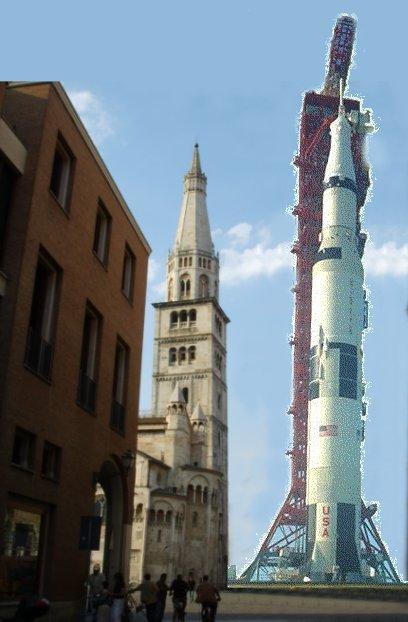
In questo articolo vorrei parlare di qualcosa di interessante ed a mio parere sconosciuto ai più, relativo ai primi momenti di ogni missione lunare, quando un razzo più alto della Ghirlandina  (110,6 Metri contro gli 86,12 della torre modenese), carico fino all’orlo di combustibile, si staccava lentamente dalla superficie terrestre.

Gli astronauti che salivano su questo razzo avevano sotto al sedere circa 1 milione 497 mila chili di cherosene e più di 92.000 Kg di idrogeno.
Alla partenza ogni motore avrebbe bruciato 3.000 Kg di combustibile al secondo, per un totale di 15.000 Kg/sec.

I primi momenti sono tra i più critici di tutta la missione e sono sotto la responsabilità diretta del “direttore di lancio” (Launch Director). Il direttore di lancio risiede al Kennedy Space Center, Cape Canaveral, Florida. Il direttore di lancio ha una grande responsabilità: deve garantire l’incolumità degli astronauti nei primissimi secondi ed il buon esito del decollo. In caso di qualunque inconveniente può decidere di annullare la missione.

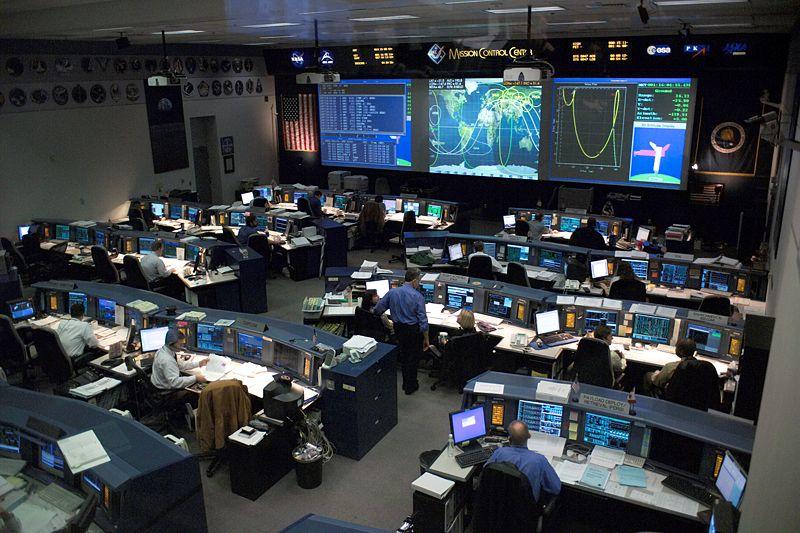
La responsabilità passa poi al direttore di volo (Flight Director), che risiede al Johnson Space Center a Houston. Il direttore di volo è a capo di tutti i controllori di volo, cioè le persone che in ogni istante controllano la telemetria di tutti i sistemi del razzo. La massa di dati da controllare contemporaneamente è gigantesca, e ancora oggi c’è bisogno di un gran numero di persone.

File:Mission control center.jpg
La moderna Flight control room dello space shuttle

Ma quando avveniva il passaggio di consegne?

Se si ascoltano le vecchie registrazioni delle missioni apollo si sente sempre che ad un certo punto il direttore di lancio dichiara “the tower is cleared”, ovvero “la torre di servizio è superata”.  La torre di servizio è quella struttura metallica che tiene il razzo ben fermo e verticale sulla rampa di lancio prima della partenza.

Il Saturn V era un razzo enorme; per poter portare gli astronauti sulla luna aveva bisogno di un gran quantitativo di combustibile: il suo peso al decollo era di 2.900 tonnellate.
Al momento della partenza i motori fornivano una spinta di 3.470 tonnellate. Nelle prime fasi la differenza tra il peso del mezzo e la spinta dei motori era piccola, per cui inizialmente il decollo era molto lento e da lontano il razzo poteva sembrare quasi immobile.
In effetti era proprio così! Nel primo secondo dopo il decollo il razzo si alzava di solo un metro! Per superare la torre di servizio occorrevano fino a 15 secondi!
I primi secondi erano interminabili: il Saturn V era molto vicino alla torre di servizio e doveva rimanere verticale per non andare a sbattere contro la LUT (Launch Umbelical Tower).
Come faceva a stare verticale un bestione così? Semplice: 4 dei 5 motori erano montati su sospensioni cardaniche che permettevano di orientare il getto dei gas combusti e dunque la spinta. Il sistema automatico di guida si accorgeva in tempo reale di piccole deviazioni dalla verticale e compensava immediatamente inclinando i motori.
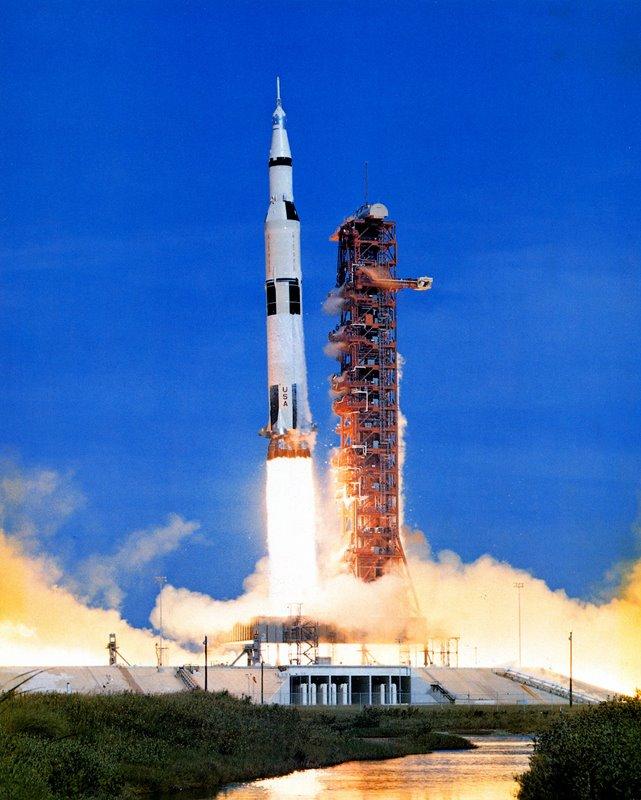
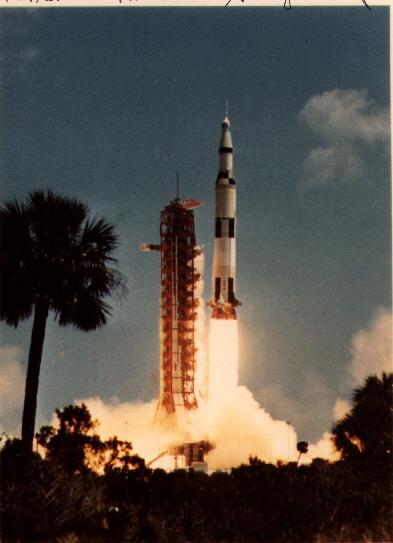
La eventualità che potesse andare a sbattere era tutt’altro che remota, tant’è che in realtà il sistema di guida era programmato per inclinare subito il razzo leggermente dalla parte opposta rispetto alla torre di servizio
Decollo del razzo Saturn V. Si può notare la leggera inclinazione dalla parte opposta rispetto alla torre di servizio.
C’era poi un altro grosso problema in questi primi 15 secondi: in caso di spegnimento di uno dei motori, i restanti 4 non avrebbero sorretto il mezzo.
Come dice Cernan nel documentario Shadow of the moon:
“It takes you 15 seconds to get past the tower.
If you lose one engine, You’re coming back down.
After that 15 seconds, if you lose one of those 5 engines, you have burned off enough fuel, you’re light enough where the four engines can sustain you.”
Se qualcosa fosse andato storto in questi primi istanti il sistema in automatico avrebbe spento i motori, o in caso di impossibilità gli astronauti avrebbero usato il LES (Launch Escape System).

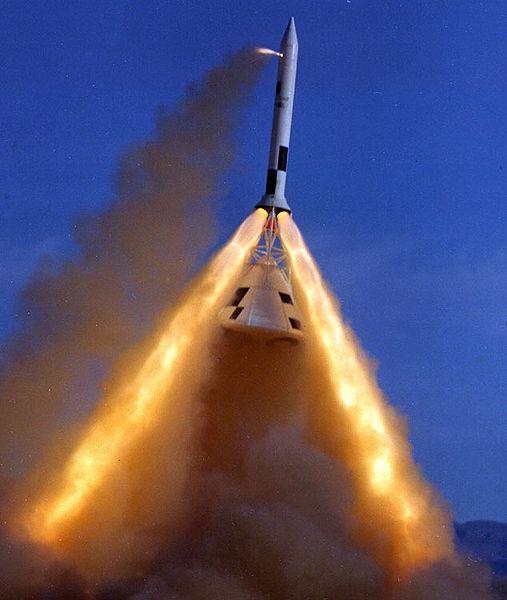
Bisogna comunque sottolineare che nessuna missione Apollo ha mai dovuto usare tale sistema; la foto a sinistra è di un test di funzionamento. Si potrebbe affermare  che nonostante partisse storto ed andasse sulla luna nessun esemplare di Saturn V durante le sue missioni ha mai avuto… la luna storta!
Lo so è una battutaccia!
Una sola volta si è reso necessario l’utilizzo di questo sistema, nel lancio della navetta sovietica Soyuz T-10-1 il 26 Settembre 1983. In tale occasione portò a termine egregiamente il suo compito, dato che gli astronauti vennero salvati.

Quando il Saturn V superava l'altezza della torre di servizio il direttore di Lancio dichiarava "Tower cleared" (cioè torre di servizio superata); la responsabilità passava dunque al direttore di volo.
Il direttore di lancio poteva tirare un sospiro di sollievo e sapeva che una marea di cose che sarebbero potute andare storte erano fortunatamente filate lisce e che lui aveva portato a termine con successo il suo compito. Da quel momento il razzo non avrebbe più avuto ostacoli attorno a sé. Il viaggio era finalmente iniziato e la missione passava sotto la responsabilità del JSC di Houston.
Oggi con le missioni Shuttle la prima fase è meno delicata e pare che il controllo missione passi la responsabilità al direttore di volo nell’istante T-0 (ovvero quello del decollo, ben prima del superamento della torre di servizio).
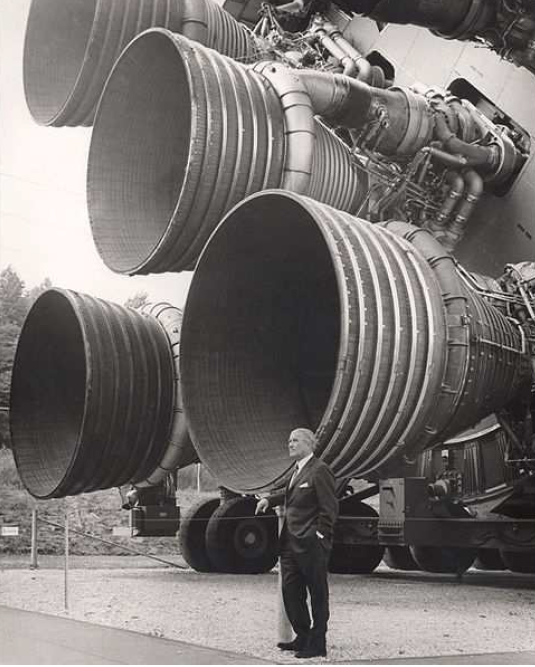
Verner Von Braun posa vicino ai motori da 3470 tonnellate di spinta del Saturno V (4 sono visibili ed uno è fuori campo):

Fonti: